Landing the Space Shuttle
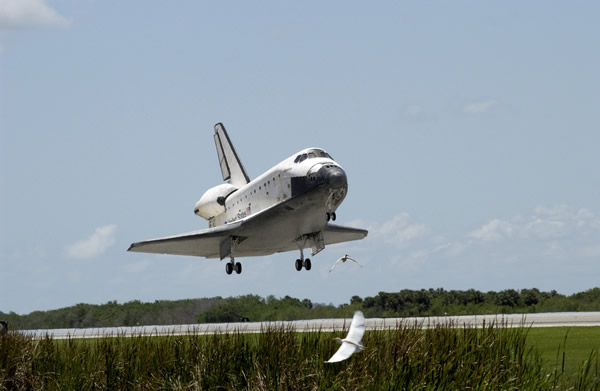 The space shuttle is an airplane – for the very final phase of a mission in any case.
During re-entry, computers are in control as, yet in the final stages of a shuttle mission, when the orbiter has returned to the atmosphere, humans take over, and the space orbiter becomes a glider.
As the orbiter slows to around Mach 3, probes deploy to provide airspeed information, and the orbiter is manoeuvred using airflow rather than thrusters. At this point it’s similar to a conventional aircraft, but has much higher speed, and rate of descent – also there are no engines that could allow the aircraft to ‘go-around’ or recover from being too low on approach (and the rocket fuel that powers the thrusters was all dumped before re-entry). It’s a one chance only event!
The approach and landing of the space shuttle orbiter is guided by a computer guidance system that helps ensure the flight doesn’t get too low and slow, or stay too high and fast – situations which would cause a crash landing. This is called being ‘on energy’. Before lining up with the runway, the pilots fly a circle which allows them to set up to approach at the right height and speed – a tighter circle if they are getting to low, a steep one if too slow – if they are too high or fast this can also be reduced with speed brakes.
Finally when the orbiter lines up with the runway, it approaches towards an outer approach point with a glide slope of 20 degrees – (commercial aircraft approach at around 3 degrees). As the altitude decreases to 2000ft, a ‘pre-flare’ stage commences and the pilot decreases the rate of descent and pitches the nose up toward the runway, for final approach at 1.5 degrees glide slope.
Here’s a great video of a real landing.
Learning to land the space shuttle.
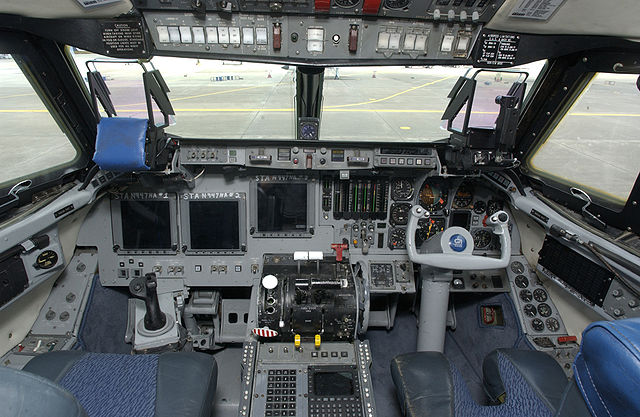
The actual space shuttle can’t be flown for practise, since it’s expensive to fly but also expensive to damage! So pilots are trained using a specially adapted aircraft, known as the Shuttle Training Aircraft (STA). This is a specially adapted Gulfstream jet, which has identical controls and displays to the shuttle, as well as adaptations and computer models that make it fly just like the shuttle. Before a pilot can land the real thing, he must have at least 1,000 practise landings in the STA – 100 sorties of 10 landings a time!